
Holiday Returns Season: How Amazon Sellers Can Prepare Before Q4 Ends


Quick Answer To choose a returns management company, compare providers on five things: whether they work with your type of product, how they price and pay you, how transparent they are about what sold, how they protect your account and brand, and how well they communicate. Ask for the process in writing, check what happens to unsold units and be cautious of any company that asks for your Amazon login. |
Why This Decision Matters
Your returns and removal orders can represent a large amount of capital. The company you choose will physically hold that inventory, represent your products to buyers and decide what recovery you see. A good partner turns a loss into steady cash. A poor one can leave you with missing units, vague reports and little recovery.
Taking an hour to compare options carefully is worth far more than the time it costs.
Criterion 1: Fit With Your Products
Not every company handles every product. Some focus on bulk liquidation of any inventory. Others focus on individual resale of recognized brands. Ask directly whether they work with your brands and your category, and whether they treat name-brand and private label items differently.
Resale works best for name-brand products, because buyers search for those brands by name. If your business is mostly name-brand, a provider built around that model is likely a better match. We explain the difference in our guide on name-brand versus private label returns.
Criterion 2: How Pricing and Payouts Work
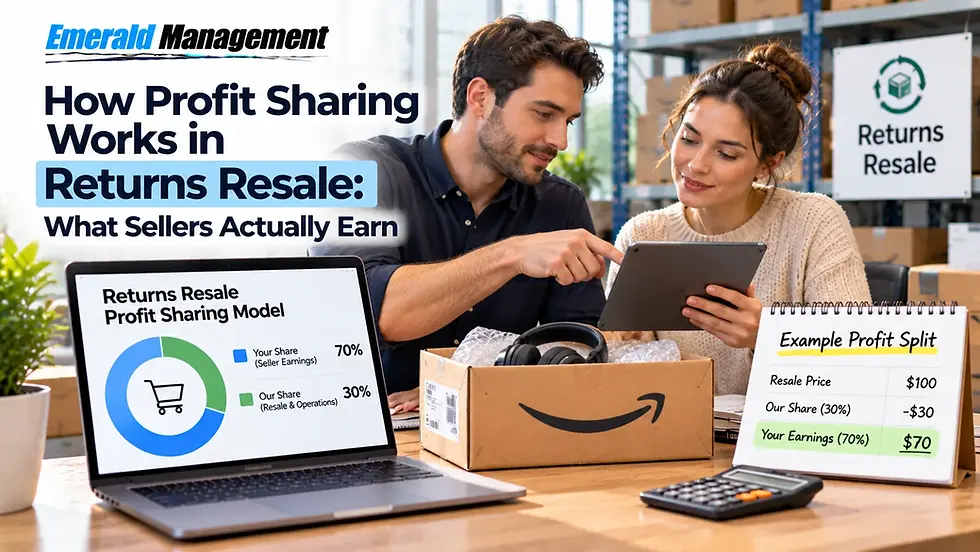
There are two common models. In a bulk buyout, the company pays a fixed price for your inventory, usually low, and takes all the risk. In a revenue share model, the company sells each unit and you receive a share of the proceeds.
Ask exactly what percentage you receive and what costs come out first
Ask how often you are paid
Ask whether there are setup, monthly or handling fees
Ask what happens to units that do not sell
There is no single right model. The important part is that the terms are clear, in writing and easy to understand.
Criterion 3: Transparency and Reporting
You should be able to see what you sent, what sold, what each item sold for and what you are owed. A monthly statement is a good minimum. If a company cannot show you this, you cannot verify your recovery. Ask to see a sample statement before you commit.
Criterion 4: Account Safety
A returns resale company does not need your Amazon password. The resale happens on its own marketplace accounts. If a provider asks for your Seller Central login as a basic requirement, treat it as a warning sign. Read our full guide on whether it is safe to give a returns company Seller Central access for what is and is not reasonable.
Criterion 5: Process and Communication
Good providers explain each step plainly: how to send inventory, how it is received, how it is inspected, how it is listed and how you are paid. Check how quickly they reply to questions before you sign anything. If they are slow or vague while trying to win your business, expect the same once you are a client.
Criterion 6: Location and Logistics
Where the facility is located affects shipping cost and transit time for removal orders. A provider closer to your fulfillment centers or your own location can reduce both. Also ask about receiving capacity and how they handle large batches at peak times.
Provider Comparison Checklist
Question to Ask | What a Good Answer Looks Like |
Do you work with my brands? | Clear yes or no, with examples |
How am I paid? | Written terms, regular schedule |
Can I see what sold? | Itemized monthly statement |
Do I need to share my login? | No, never required |
What about unsold units? | A stated policy, not a vague promise |
Who do I talk to? | A real contact who responds quickly |
Red Flags to Watch For
Requests for your Amazon email and password
Guaranteed high recovery with no explanation
No clear statement of how payouts are calculated
Reluctance to put terms in writing
No physical address or real contact details
Start With a Small Test Shipment
If you are unsure, send a small batch first. This lets you see the process, the communication and the reporting before you commit your full volume. Most reliable providers are comfortable with this approach. To understand what a typical process looks like from start to finish, read how a returns resale service works.
You can also review our frequently asked questions to see how we answer these same questions about pricing, process and account access.
Questions About Your Specific Situation
Every business is a little different. If you sell mostly on Amazon, ask how the provider handles FBA removal orders. If you also sell on Walmart, ask whether they receive WFS inventory too. If you carry seasonal products, ask how they time listings. A provider that answers these specifics confidently usually has real experience.
Look for Clear Boundaries
A trustworthy company is clear about what it does and does not do. It will tell you which products it accepts, what condition it expects and what it will decline. Clear boundaries protect both sides. They prevent surprises, avoid wasted shipping costs and set honest expectations about recovery.
Check How They Handle Problems
Even the best process hits issues now and then, such as a damaged unit, a count that does not match or a buyer dispute. Ask how the provider handles these situations and who you speak to. How a company deals with problems tells you more about its quality than how it describes its best days.
Finally, trust your instincts about the relationship. You will be working with this partner month after month, so clear and friendly communication matters as much as the numbers.
Put the Comparison in Writing
Make a simple table with each provider you are considering. List payout terms, fees, reporting, location and response time. Seeing the answers side by side usually makes the best choice obvious and keeps you from deciding on charm or price alone.
Take your time. A careful decision now protects your inventory and your margins for months to come.
Frequently Asked Questions
Q: What should I look for in a returns management company?
Look for fit with your products, clear payout terms, itemized reporting, safe account practices and responsive communication.
Q: Is a bulk buyout or revenue share better?
A bulk buyout is faster but usually pays less. A revenue share can recover more for name-brand items but pays gradually as units sell.
Q: Should I send all my inventory at once?
It is wise to start with a small test shipment so you can evaluate the process and reporting first.
Q: Do I need to give a returns company my Amazon login?
No. A returns resale company works from the physical inventory you send, not from your Seller Central account.
See How We Answer These Questions
We are happy to walk you through our process, payouts and reporting. Get a free quote and ask us anything before you send a single unit.


Comments